Digital Marketing for Therapists: What You Need to Know to Grow Your Practice Online
You went to school to help people heal, not to learn marketing. But if you run a private practice, the reality is that clients need to find you before you can help them. And in today's world, that almost always starts with a Google search or an AI chat.
The good news? You do not need to become a marketing expert overnight. This guide walks you through the most important digital marketing concepts every therapist should understand, explained in plain language with no jargon overload.
Let's dig in.
What Is Digital Marketing for Therapists?
Digital marketing is simply the act of promoting your therapy practice online. That includes your website, how you show up in search results, and even how people talk about you on directories like Psychology Today or Yelp.
Unlike traditional advertising (think: flyers, newspaper ads), digital marketing lets you reach people who are actively searching for help. That is a huge advantage, because someone Googling "anxiety therapist near me" is already raising their hand and saying they need support.
The four pillars of digital marketing every therapist should understand are:
SEO (Search Engine Optimization)
AEO (Answer Engine Optimization)
CAC (Client Acquisition Cost)
LTV (Lifetime Value)
We will break each one down below.
SEO for Therapists: How to Show Up on Google
What Is SEO?
SEO stands for Search Engine Optimization. It is the practice of making your website more visible in search engine results like Google. When someone types in "therapist for trauma in [your city]," SEO is what determines whether your website shows up on page one or page five.
The higher you rank, the more people find you. The more people find you, the more potential clients you get. Simple as that.
Why Does SEO Matter for Your Practice?
Most people do not scroll past the first few results on Google. If your website is buried, you are essentially invisible to potential clients. SEO helps you compete without spending money on ads. That’s why we started TherapySEO.
It is also a long-term investment. Unlike paid advertising, which stops the moment you stop paying, good SEO keeps working for you month after month.
What Are the Basic Components of SEO?
There are three core pieces:
1. Keywords Keywords are the words and phrases your ideal clients type into Google. Think things like:
"CBT therapist in Austin"
"grief counselor near me"
"online therapy for depression"
You want to use these phrases naturally throughout your website, especially in your page titles, headings, and the first paragraph of your content.
A free tool to find keywords: Google Keyword Planner or Ubersuggest.
2. On-Page SEO This refers to everything on your actual website pages. Key things to focus on:
Write a clear, keyword-rich title for each page (example: "Anxiety Therapist in Denver | Jane Smith, LCSW")
Use headings (H1, H2) to structure your content
Write a short meta description for each page (the little summary that shows up under your link in Google)
Make sure your site loads quickly and works well on mobile phones
3. Off-Page SEO This is about building your reputation outside your website. The biggest factor here is backlinks, which are other websites linking to yours. Getting listed on therapist directories like Psychology Today, TherapyDen, and Alma is a great place to start because they link back to your site.
How Do You Measure SEO?
Use these free tools to track how your SEO is performing:
Google Search Console (free): Shows you which keywords people used to find your site, how often your site appears in search, and how many people clicked through.
Google Analytics (free): Shows you how many people visited your website, where they came from, and what pages they looked at.
Key numbers to watch:
Impressions: How many times your website showed up in search results
Clicks: How many people actually clicked on your link
Click-through rate (CTR): Clicks divided by impressions, expressed as a percentage. A healthy CTR for therapy websites is typically 3-5%.
Average position: Your average ranking in Google results. A position of 1-10 means you're on the first page.
Clients: Remember, you’re doing SEO to drive your business so the ultimate success metric is how many clients you get from it. You can track this digitally or even anecdotally by asking clients where they found you.
AEO for Therapists: Showing Up in AI Answers
What Is AEO?
AEO stands for Answer Engine Optimization. It is a newer and increasingly important cousin of SEO.
While SEO focuses on getting your website to show up in a list of search results, AEO focuses on getting your content to be the direct answer that shows up at the top of a search page, or inside AI tools like ChatGPT, Google's AI Overview, or voice assistants like Siri and Alexa.
You have probably noticed that when you Google a question, sometimes an answer box appears right at the top before any links. That is an "answer engine" response, and AEO is how you get featured there.
Why Does AEO Matter for Therapists?
More and more people are asking questions in a conversational way, either by typing full questions into Google or speaking them out loud. They are also increasingly turning to AI chatbots to find recommendations, including for mental health professionals.
If your website content directly answers the questions potential clients are asking, you have a much better shot at being the answer that gets surfaced, whether in a search result box or an AI-generated response.
How Do You Optimize for AEO?
The key is to write content that directly and clearly answers real questions your potential clients are asking.
Here are some practical steps:
Write FAQ sections on your website. Use actual questions as headings. For example:
"What can I expect in my first therapy session?"
"Do you offer online therapy?"
"How much does therapy cost?"
Then answer each question clearly and concisely right below the heading.
Use conversational language. Write the way people actually talk and search. Avoid heavy clinical jargon.
Structure your content clearly. Use short paragraphs, clear headings, and bullet points. AI tools and search engines can extract and understand structured content much more easily.
Claim your Google Business Profile. This is a free listing that shows up when people search for therapists in your area. Fill it out completely, including your specialty areas, hours, and a warm description of your practice.
AEO for Therapists: Showing Up in AI Answers
What Is AEO?
AEO stands for Answer Engine Optimization. It is a newer and increasingly important cousin of SEO.
While SEO focuses on getting your website to show up in a list of search results, AEO focuses on getting your content to be the direct answer that shows up at the top of a search page, or inside AI tools like ChatGPT, Google's AI Overview, or voice assistants like Siri and Alexa.
You have probably noticed that when you Google a question, sometimes an answer box appears right at the top before any links. That is an "answer engine" response, and AEO is how you get featured there.
Why Does AEO Matter for Therapists?
More and more people are asking questions in a conversational way, either by typing full questions into Google or speaking them out loud. They are also increasingly turning to AI chatbots to find recommendations, including for mental health professionals.
If your website content directly answers the questions potential clients are asking, you have a much better shot at being the answer that gets surfaced, whether in a search result box or an AI-generated response.
How Do You Optimize for AEO?
The key is to write content that directly and clearly answers real questions your potential clients are asking. Here are some practical steps:
Write FAQ sections on your website. Use actual questions as headings. For example:
"What can I expect in my first therapy session?"
"Do you offer online therapy?"
"How much does therapy cost?"
Use conversational language. Write the way people actually talk and search. Avoid heavy clinical jargon.
Structure your content clearly. Use short paragraphs, clear headings, and bullet points. AI tools and search engines can extract and understand structured content much more easily.
Claim your Google Business Profile. This is a free listing that shows up when people search for therapists in your area. Fill it out completely, including your specialty areas, hours, and a warm description of your practice.
How Do You Measure AEO?
AEO is harder to measure directly than SEO, but here are some signals to watch:
In Google Search Console, check if any of your pages are showing up as "featured snippets" (the answer box at the top of search results).
Track whether your website is being mentioned in AI tool responses by occasionally searching for your specialty area and location in tools like ChatGPT or Google's AI Overview.
Monitor your website traffic over time. As your AEO improves, you should see an increase in visitors from search.
CAC for Therapists: Understanding What It Costs to Get a New Client
What Is CAC?
CAC stands for Client Acquisition Cost. It is the average amount of money you spend on marketing and outreach to bring in one new client.
Think of it this way: if you spend $200 a month on a Psychology Today listing and that listing brings in 4 new clients per month, your CAC is $50 per client.
Why Does CAC Matter?
Knowing your CAC tells you whether your marketing dollars are working. If you are spending a lot of money to get clients but the math does not add up, something needs to change. If your CAC is low and clients are coming in steadily, you know to keep doing what you are doing.
How Do You Calculate CAC?
CAC = Total Marketing Spend / Number of New Clients Acquired
Example:
You spend $300/month on a Psychology Today listing
You spend $100/month on Google Ads
You get 5 new clients that month
$400 divided by 5 = $80 CAC
That means it costs you $80 on average to acquire each new client.
What Is a Good CAC for a Therapy Practice?
This depends on your rates and how long clients typically stay with you (that is where LTV comes in, more on that below). As a general benchmark:
If a client pays $150 per session and comes for 10 sessions, they bring in $1,500
A CAC of $80-$150 would be very reasonable in that scenario
A CAC of $500 or more would be a warning sign worth investigating
How Do You Track CAC?
Ask every new client how they found you. You can do this on your intake form with a simple question: "How did you hear about us?" Then track the source in a simple spreadsheet each month. Over time, you will see which marketing channels are delivering the most clients for the least cost.
LTV for Therapists: The Long-Term Value of Each Client
What Is LTV?
LTV stands for Lifetime Value. It refers to the total revenue a single client brings to your practice over the entire course of your work together.
This is one of the most overlooked numbers in a therapy practice, and one of the most powerful.
Why Does LTV Matter?
Understanding LTV helps you see the big picture. A client who comes in for one session is worth very little in LTV. A client who comes weekly for two years is worth a great deal. When you know your average LTV, you can make smarter decisions about how much you are willing to spend to acquire a new client (your CAC).
A useful rule of thumb: your CAC should ideally be no more than 10-20% of your LTV.
How Do You Calculate LTV?
LTV = Average Session Fee x Average Sessions Per Client
Example:
Your session fee is $175
On average, clients come for 20 sessions
$175 x 20 = $3,500 LTV
If your LTV is $3,500 and your CAC is $100, your marketing investment is paying off very well.
You can also factor in referrals. If a satisfied client refers even one other client, your effective LTV doubles. This is another great reason to invest in the client experience.
How Do You Track LTV?
Keep a simple record of each client's start date, end date, and number of sessions completed. You can do this in a spreadsheet or through your practice management software (like SimplePractice or TherapyNotes). If you have the channels properly marked, you can even upload it to ChatGPT or Claude to do the calculations (but be sure to double check because those AIs can make things up).
After a few months, you will have enough data to calculate an average. Revisit this number quarterly as your practice grows.
Putting It All Together: A Simple Digital Marketing Framework for Therapists
Here is a framework to keep you grounded:
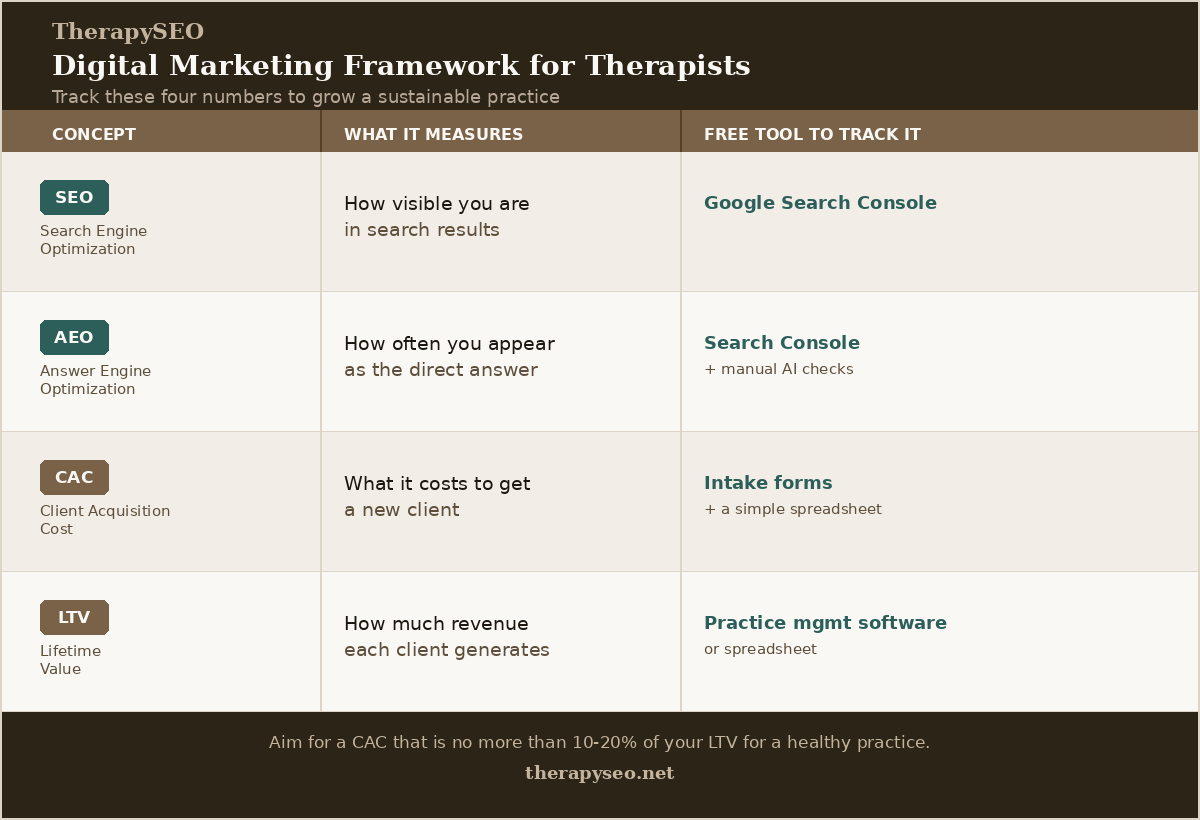
You do not need to nail all four at once. Start with one. A great first step is to:
Set up a free Google Search Console account and connect it to your website
Add an FAQ section to your website that answers the most common questions your clients ask
Start asking every new client how they found you
That alone puts you ahead of most therapy practices.
Frequently Asked Questions About Digital Marketing for Therapists
Do I need a big budget to market my therapy practice?
No. Many of the most effective strategies, including SEO, AEO, and a Google Business Profile, are completely free. Paid advertising can help accelerate growth, but it is not required to build a steady client base.
How long does SEO take to work?
SEO is a long game. Most practices start seeing meaningful results in three to six months, with stronger results building over one to two years. The earlier you start, the better.
Should I be on social media?
Social media can be a helpful supplement, but it is not a replacement for SEO and a strong website. If you enjoy it and have the time, it can help build trust and visibility. If it feels overwhelming, focus on your website first.
What is the difference between SEO and AEO?
SEO helps your website rank in the list of search results. AEO helps your content become the direct answer shown at the top of the page, inside AI tools, or through voice search. Both matter, and a lot of the work overlaps.
What if I am not tech-savvy?
Start small. You do not need to do everything at once. Set up Google Search Console, add an FAQ to your site, and ask new clients how they found you. Those three steps alone will give you valuable data and a stronger foundation.
Final Thoughts
Digital marketing can feel like a lot, especially when your real passion is helping people, not analyzing metrics. But think of it this way: the better your marketing works, the more people you can actually reach and help.
You do not need to become an expert. You just need to understand the basics, track a few key numbers, and keep improving over time. Start with SEO and AEO to get found, then use CAC and LTV to make sure your efforts are paying off.
Your future clients are out there searching right now. Let's make sure they can find you.