
The 5 Most Common Therapist Website SEO Mistakes (And How to Fix Them)
You have a website. Maybe you even spent real time and money building it. But if new clients are not finding you through Google, something is getting in the way.
Most of the time, it is not one dramatic problem. It is a handful of quiet mistakes that are easy to make, especially when no one has ever explained the rules to you.
Here are the five most common SEO mistakes therapists make on their websites, why each one matters, and exactly what to do about it.
Mistake 1: Writing Your Website for Other Therapists Instead of Your Clients
This is the single most widespread mistake on therapist websites, and it is completely understandable. You have spent years in graduate programs and training environments where clinical language is the norm. Terms like "evidence-based modalities," "somatic experiencing," "psychodynamic approach," and "attachment-informed treatment" are everyday vocabulary for you.
They are not everyday vocabulary for the person sitting at their kitchen table at 11pm, heart racing, searching Google for help.
Why this matters for SEO: Google's job is to match search results to what people actually type. If your website says "evidence-based trauma treatment" but your potential client typed "therapist to help with PTSD near me" or "why do I keep having flashbacks," your page does not look like a match. Google moves on.
The phrases people actually search for are messy, personal, and symptom-based. They sound more like:
"therapist for anxiety near me"
"why do I feel sad all the time"
"online couples counseling that takes insurance"
"help for panic attacks in [city]"
None of those phrases include the word "modality."
How to fix it: Go through your service pages and ask yourself: would a person in distress, with no clinical background, recognize themselves in this language? If not, rewrite those sections in the words your clients actually use. You can still mention your modalities and credentials, but lead with the problem you solve, in plain language.
A page that starts with "Are you struggling with anxiety that is making it hard to get through your day?" will outperform one that starts with "I offer integrative, evidence-based approaches to anxiety disorders" in search results, every time.
Mistake 2: Having One General "Services" Page Instead of Separate Pages for Each Specialty
Many therapist websites have a single page that lists everything they treat: anxiety, depression, trauma, relationships, grief, life transitions, and more. It feels organized. It looks clean. And it is quietly killing your search visibility.
Why this matters for SEO: Google ranks individual pages, not entire websites. When someone searches for "trauma therapist in Austin," Google is looking for a page that is specifically, clearly, and thoroughly about trauma therapy in Austin. A page that mentions trauma once in a list of twelve things is not that page.
A single services page cannot rank well for any specific search because it is trying to be everything at once. It ends up ranking for nothing in particular.
How to fix it: Create a separate page for each specialty or condition you treat. Each page should:
Have a specific, keyword-rich title (example: "Anxiety Therapy in [Your City] | [Your Name]")
Be at least 300 to 400 words long
Describe what that condition feels like for the person experiencing it
Explain your approach in plain language
Include a clear next step (a contact form or a link to book a consultation)
Answer two or three common questions about that type of therapy
If you help with anxiety, depression, and trauma, those are three separate pages. If you also see couples and offer telehealth, add those too. Each page is its own opportunity to show up in a specific search.
Mistake 3: Ignoring Your Google Business Profile (or Never Setting One Up)
Your Google Business Profile is the listing that shows up in Google Maps and in the local results block that appears near the top of the page when someone searches for a therapist in your area. It is often the first thing potential clients see, even before they visit your website.
And a large number of therapists either do not have one, have never claimed it, or set it up once and forgot about it.
Why this matters for SEO: For local searches, your Google Business Profile can matter as much as, or sometimes more than, your actual website. Practices with verified, complete, active profiles appear in local results at dramatically higher rates than those with incomplete or unclaimed profiles.
Clients searching "therapist near me" are high-intent searchers. They are ready to reach out to someone. If your profile is missing or looks abandoned, they click on the next listing.
How to fix it: Start by searching for your practice name on Google to see if a profile already exists. If it does, claim it. If it does not, create one at business.google.com.
Once you have access, make sure:
Your name, address, and phone number exactly match what is on your website
Your business category is set appropriately (for example: "Psychologist," "Mental Health Clinic," "Marriage Counselor")
Your hours are accurate and up to date
Your website link is correct
Your description clearly explains what you do and who you help
You have at least a few professional photos
After setup, treat your profile as a living thing, not a one-time task. Update it when your hours change. Add a post when you have something to share. Respond to any reviews you receive. Google rewards active profiles with better visibility.
Mistake 4: Not Including Your Location Anywhere Meaningful on Your Website
It sounds almost too obvious to be a real mistake. And yet, a surprising number of therapist websites mention their city only in their footer, or not at all, because the therapist assumes people will know where they are located.
Google does not assume. It reads your pages.
Why this matters for SEO: When someone searches for "therapist in Denver," Google looks for pages that clearly signal they are relevant to Denver. If your website does not include your city, neighborhood, or service area in your page titles, headings, and body copy, Google has no way to know you should show up for that search. This local SEO for therapists is very important.
This mistake is especially common among therapists who offer telehealth. Because they see clients remotely, they sometimes leave out location information entirely, when in reality clients still often search using city or state terms even when looking for online therapy.
How to fix it: Include your city or service area naturally throughout your website. It does not need to feel forced or repetitive. Some practical places to add it:
Your homepage headline or the first paragraph of your homepage
The title and first paragraph of each service page
Your About page
Your page titles and meta descriptions (the text Google shows in search results)
A dedicated location or contact page that clearly states where you practice and any service areas you cover
If you offer telehealth across multiple states, a line like "I offer online therapy to clients across California, Oregon, and Washington" goes a long way toward helping Google understand your reach.
Mistake 5: Publishing Thin, Generic Blog Content (or No Blog at All)
The idea of blogging can feel like a big lift, so many therapists either skip it entirely or write a few short, generic posts and leave them untouched for years. Neither approach does much for your SEO.
Why this matters for SEO: Blog content is how you build what Google calls topical authority. The more clearly and thoroughly your website covers topics related to your specialty, the more Google comes to see your site as a credible resource on those subjects. More content also means more chances to show up in search for the many different ways people search for help.
Generic content, like "5 Tips for Managing Stress," that sounds identical to every other wellness website does not help you stand out. Thin content, like a 150-word post, does not give Google enough to work with. And no content at all leaves a lot of potential traffic on the table.
How to fix it: You do not need to post every week or write anything that looks like a clinical research paper. The most effective therapy blog content tends to be:
Written in the words your clients actually use, not clinical jargon
Focused on one specific question or topic, not a broad overview
Long enough to be genuinely useful (typically at least 500 to 800 words)
Specific to your specialty and the people you serve
A few strong, specific posts will always outperform a large number of thin, generic ones. Start with the questions you hear most often in your practice. Each one of those is a blog post that someone is probably already searching for.
Frequently Asked Questions About Therapist Website SEO Mistakes
How do I know if my website is making these mistakes? The quickest way to get a picture of your current SEO health is to set up Google Search Console (it is free) and look at what searches your site is showing up for, how often, and where you rank. If you are showing up for almost nothing, or only for your own name, the issues above are likely contributors.
Do I need to hire someone to fix these issues? Not necessarily. Mistakes 1, 2, and 4 are things most therapists can address on their own with some focused time and attention. Mistake 3 just requires claiming and completing your Google Business Profile. Mistake 5 requires consistent effort but not technical skill. Where professional help tends to pay off the most is in identifying technical issues that are harder to spot without experience, and in developing a content strategy that goes beyond trial and error.
How long will it take to see results after I fix these issues? Some improvements, especially to your Google Business Profile, can show results relatively quickly, sometimes within a few weeks. Larger changes to your website content will take longer, typically 3 to 6 months, before you see meaningful ranking movement. SEO is a long game, but fixing foundational mistakes makes everything else work better.
What is the most important fix to start with? If you have not claimed and optimized your Google Business Profile yet, start there. It is free, it is the fastest path to local visibility, and it is something many therapists have not done properly. After that, focus on creating separate pages for your specialties.
A Note on What Not to Do
While you are working through these fixes, it is worth knowing what to avoid as well. Do not try to stuff keywords unnaturally into your pages. Do not create duplicate pages targeting slightly different city names with identical content. Do not buy backlinks from link farms. And do not publish content that was entirely written by AI with no personal review or clinical judgment applied.
Google's standards for health content are high. The goal is not to trick the algorithm. It is to make your expertise genuinely visible and accessible to the people who need it. When you approach SEO that way, the results tend to stick.
Quick Answers: Common Therapist SEO Mistakes
Why is my therapy website not showing up on Google? The most common reasons are: your content uses clinical language instead of the words clients actually search for, you have one general services page instead of separate pages for each specialty, your Google Business Profile is incomplete or unclaimed, your city or location is not mentioned on your website, or your content is too thin or generic for Google to rank.
What is the most common SEO mistake therapists make? Writing for other therapists instead of for clients. Using clinical terms like "evidence-based modalities" instead of plain-language descriptions like "help for anxiety or panic attacks" means your pages do not match what people actually type into Google.
Do therapists need a separate page for each service? Yes. A single services page that lists everything you treat cannot rank well for any specific search. Google ranks individual pages, and each specialty or condition deserves its own dedicated page to have a real chance of appearing in relevant search results.
How important is Google Business Profile for therapists? Extremely important. For local searches, your Google Business Profile can be as influential as your actual website. Practices with complete, verified, active profiles appear in local results at significantly higher rates than those with incomplete or abandoned profiles.
Does my therapy website need to mention my city? Yes. If your location is only in your footer or missing entirely, Google does not know to show your site for location-based searches. Your city should appear naturally in your page titles, headings, and body copy.
How long does it take to see results after fixing SEO mistakes? Google Business Profile improvements can show results in weeks. Content and page structure changes typically take 3 to 6 months to reflect in rankings. The impact builds over time, and fixing foundational mistakes makes every future SEO effort more effective.
Key Takeaways
Writing in clinical language is the most widespread SEO mistake on therapist websites. Use the words your clients actually search for
A single catch-all services page cannot rank for specific searches. Create a dedicated page for each specialty you treat
Your Google Business Profile is often the first thing a potential client sees. Claim it, complete it, and keep it active
If your city or service area is not mentioned on your pages, Google cannot rank you for local searches
Generic or thin blog content does not build authority. Specific, client-focused posts of at least 500 words perform far better
The Google Business Profile is the fastest fix available and costs nothing
Fixing these five mistakes does not require a technical background. Most of them are about content and clarity
After fixing content issues, expect 3 to 6 months before rankings meaningfully improve
Do not stuff keywords, create filler city pages, or publish unreviewed AI content. Google's standards for health sites are high
The goal of SEO is not to trick an algorithm. It is to make your real expertise visible to the people searching for exactly what you offer

How Long Does SEO Take for a Therapy Practice? A Realistic Timeline
You start investing in SEO for your therapy practice. You update your website, add some keywords, maybe write a blog post. Then you wait.
And wait.
And then you start wondering: is this actually working?
If that sounds familiar, you are not alone. SEO timelines are one of the most misunderstood parts of growing a practice online. Agencies oversell quick wins. Therapists get frustrated and quit. And a lot of good work gets abandoned right before it starts paying off.
This article gives you an honest, data-backed answer to how long SEO actually takes for a therapy practice, and what you can realistically expect month by month.
How Long Does SEO Take for a Therapy Practice?
The short answer: most therapy practices start seeing meaningful results between months 3 and 6, with stronger, more reliable results between months 6 and 12.
But that answer comes with important context. Therapy websites are not typical businesses. Google classifies mental health content as a high-stakes category that requires extra scrutiny before ranking. That means the timeline is a little longer than it might be for, say, a coffee shop or a clothing boutique — and for good reason.
Here is what the data shows:
Google has officially stated that SEO typically takes 4 months to a year to produce significant results for most websites
Medical and mental health practice websites see gradual improvements over 6 to 9 months on average, partly due to the stricter credibility standards Google applies to health content
60% of SEO practitioners report seeing initial ranking improvements in about 4 to 6 months
76% of businesses that commit to SEO beyond 12 months end up with 40% more organic leads compared to those that stop earlier
The key word in all of that is "commit." SEO is not a one-time fix. It is a steady process that compounds over time.
Why Does SEO Take Longer for Therapy Practices Specifically?
Before you look at the month-by-month breakdown, it helps to understand why therapy SEO takes as long as it does.
There are three main reasons.
1. Google holds health content to higher standards. Therapy websites fall under a category Google calls YMYL, which stands for Your Money or Your Life. This means Google applies extra scrutiny before ranking your pages, because giving someone bad advice about their mental health carries real consequences. Before your content ranks, Google needs to be confident that you are a real, credible professional. Building that credibility takes time.
2. Trust signals take time to accumulate. Google looks for signals from across the web to confirm your practice is legitimate: directory listings, backlinks from other reputable sites, a complete Google Business Profile, consistent information across platforms, and reviews. None of those appear overnight.
3. New content needs time to get indexed and tested. When you publish a new page or post, Google first has to find it, then index it, then test how users respond to it in search results before deciding where to rank it permanently. That process alone can take weeks.
Month-by-Month: What to Expect From Therapy Practice SEO
Here is a realistic picture of what typically happens across the first 12 months.
Months 1 to 2: Foundation Work (Do Not Expect Rankings Yet)
This phase is about getting your house in order. If you or your SEO provider are doing things right, months 1 and 2 are spent on:
Fixing any technical issues (slow load speed, mobile problems, broken pages)
Setting up or cleaning up your Google Business Profile
Conducting keyword research to understand what your ideal clients actually search for
Optimizing your existing pages: titles, headings, meta descriptions
Making sure Google can properly crawl and index your site
What you will see: Not much yet, and that is normal. You might notice your site appearing in Google Search Console for the first time, or see a small bump in impressions. Rankings during this phase are largely irrelevant. The work being done now is the foundation everything else is built on.
Months 3 to 4: Early Signs of Life
This is when things start to get interesting. New content you published in months 1 and 2 starts getting indexed. Google is testing your pages in search results to see how real users respond.
You may start ranking for longer, more specific searches, called long-tail keywords. For example, you might not show up for "anxiety therapist" yet, but you might start appearing for "online anxiety therapist for adults in [your city]."
What you will see: A gradual increase in impressions in Google Search Console. Your first organic clicks for long-tail searches. Possibly your first organic inquiry from someone who found you through search. Local rankings may start improving if your Google Business Profile is optimized.
Months 5 to 6: Momentum Builds
This is where consistency starts to pay off. Your domain is building credibility. Your content is getting tested and settling into rankings. If you have been adding new pages or blog posts, those are also starting to accumulate authority.
Most therapy practices see their first reliable, consistent uptick in organic traffic somewhere in this window. You may start appearing on the first page of results for some of your target keywords.
What you will see: A noticeable increase in organic website traffic. More keyword rankings appearing in Search Console. A more consistent flow of inquiries from people who found you through Google. Local map pack appearances becoming more frequent.
Months 7 to 9: Things Get Real
By now, your earlier work is compounding. Content published months ago is still gaining authority and ranking higher over time. Your Google Business Profile is more established. Your domain has more credibility signals.
If you are in a less competitive market, this is often the phase where SEO becomes your most reliable source of new client inquiries. Competitive markets take a little longer to reach this point.
What you will see: Multiple first-page rankings for your specialty and location keywords. Steady organic traffic. Inquiries coming in through search on a consistent basis. A noticeably stronger local presence.
Months 10 to 12: SEO Becomes an Asset
At this point, you have a full picture of what is working. Earlier content continues to earn traffic passively. Your domain authority is solidifying. New content ranks faster than it did in month 1 because Google has come to trust your site.
The question shifts from "is this working?" to "how do we keep building on this?"
What you will see: Organic search becoming one of your primary sources of new client inquiries. Your site appearing in AI-generated search answers for relevant queries. Compound growth where each new piece of content builds on the authority of everything before it.
What Makes the Timeline Shorter or Longer?
Not every practice will follow this exact timeline. Several factors can speed things up or slow them down.
Things that speed up your results:
Starting with a website that already has some history and credibility (versus launching a brand-new domain)
Being in a less competitive market or a smaller city
Having consistent, accurate information across all your online listings
Publishing helpful, specific content regularly
A well-optimized Google Business Profile from day one
Getting listed on reputable directories like Psychology Today, TherapyDen, and your state's professional association
Things that slow down your results:
A brand-new website with no history
A highly competitive market with many established therapists already ranking well
Thin or generic content that does not match what clients actually search for
Technical problems on your site that prevent Google from properly reading it
Inconsistent information across platforms (different phone numbers, addresses, or practice names)
The Most Common Reason Therapists Do Not See Results
Here is the truth: most therapists who feel like SEO "did not work" for their practice quit too early.
Months 1 and 2 feel like nothing is happening. Month 3 shows tiny signs of movement. Month 4 starts to build. And then they stop.
The practices that stop at month 3 never get to see what months 6, 9, and 12 look like. And by that point, their competitor down the street who kept going is ranking on page one.
SEO rewards consistency above almost anything else. The timeline is predictable for practices that stick with it. It is unpredictable for those who do not.
Frequently Asked Questions About SEO Timelines for Therapists
How long until I start getting client inquiries from SEO? Most therapy practices see their first organic inquiries somewhere between months 3 and 5, usually starting with long-tail, specific searches. A steady, reliable flow of inquiries typically develops between months 6 and 9.
Does local SEO happen faster than regular SEO? Yes. Optimizing your Google Business Profile and targeting local searches often shows results faster than ranking for broader keyword terms. Some practices see local ranking improvements within weeks of cleaning up their Google Business Profile. Local SEO is a great place to start for that reason.
What if I am in a competitive city? Competitive markets take longer. If you are in a city like New York, Los Angeles, or Chicago, you may be looking at the 9 to 12 month end of the timeline before seeing consistent results. That is not a reason to avoid SEO. It is a reason to start sooner.
Does blogging speed up my results? Yes. Practices that publish useful content regularly tend to rank for more keywords and build authority faster. It does not need to be daily. Even one well-researched, client-focused post per month compounds meaningfully over time.
What should I track to know if SEO is working? Start with Google Search Console. Watch your impressions (how often you appear in search), your clicks, and your average position over time. An upward trend in any of those numbers, even a slow one, is a sign that the work is working. Ask new clients how they found you and log the answers.
The Bottom Line on SEO Timelines for Therapy Practices
SEO is not fast. It is also not magic. It is a steady, compounding investment that rewards the practices that treat it that way.
Most therapists who stick with it for 6 to 12 months find that it becomes one of their most reliable sources of new client inquiries, without the ongoing cost of directory subscriptions or the unpredictability of referrals.
The practices that are filling their caseloads through organic search today are mostly the ones who started 6 to 12 months ago and kept going.
The best time to start was then. The second-best time is now.
Quick Answers: SEO Timeline for Therapists
How long does SEO take for a therapy practice? Most therapy practices see meaningful results between 3 and 6 months, with reliable, compounding results building between months 6 and 12. Therapy websites take slightly longer than average because Google applies stricter standards to mental health content.
When will I see my first client inquiry from SEO? Most practices receive their first organic inquiry between months 3 and 5, typically from specific, long-tail searches like "anxiety therapist in [city]." A consistent flow of inquiries usually develops between months 6 and 9.
Does local SEO take as long as regular SEO? No. Local SEO, especially Google Business Profile optimization, often shows results in weeks rather than months. It is the fastest win available and the best place to start.
How long does SEO take for a new therapy website with no history? Expect the longer end of the timeline, typically 6 to 12 months for meaningful results. A brand-new domain with no authority history takes more time for Google to evaluate and trust.
Why does therapy SEO take longer than other industries? Google holds mental health websites to higher credibility standards because the content can directly affect someone's health and wellbeing. Building the trust signals Google needs to rank your site takes time, but once established, those signals are durable.
Is SEO worth it for a therapy practice? Yes. Unlike paid directories that stop delivering the moment you stop paying, SEO builds lasting visibility that compounds over time. A well-optimized therapy website can bring in new client inquiries for years from a single piece of work.
Key Takeaways
Google officially states that SEO takes 4 months to a year to produce significant results for most websites
Therapy and mental health websites fall under Google's YMYL category, which means stricter standards and a slightly longer timeline
Local SEO and Google Business Profile optimization are the fastest wins, sometimes showing results within weeks
Most therapy practices see their first organic inquiries between months 3 and 5
Consistent, compounding growth typically kicks in between months 6 and 12
The single most common reason SEO fails for therapists is quitting before the results arrive
Competitive markets take longer, which is a reason to start earlier, not a reason to skip SEO
Blogging regularly, even just once a month, significantly accelerates how quickly your site builds authority
Track impressions, clicks, and average position in Google Search Console to measure progress before client inquiries pick up
SEO is a long-term asset, not a short-term tactic. Practices that treat it that way consistently outperform those that do not

Digital Marketing for Therapists: What You Need to Know to Grow Your Practice Online
You went to school to help people heal, not to learn marketing. But if you run a private practice, the reality is that clients need to find you before you can help them. And in today's world, that almost always starts with a Google search or an AI chat.
The good news? You do not need to become a marketing expert overnight. This guide walks you through the most important digital marketing concepts every therapist should understand, explained in plain language with no jargon overload.
Let's dig in.
What Is Digital Marketing for Therapists?
Digital marketing is simply the act of promoting your therapy practice online. That includes your website, how you show up in search results, and even how people talk about you on directories like Psychology Today or Yelp.
Unlike traditional advertising (think: flyers, newspaper ads), digital marketing lets you reach people who are actively searching for help. That is a huge advantage, because someone Googling "anxiety therapist near me" is already raising their hand and saying they need support.
The four pillars of digital marketing every therapist should understand are:
SEO (Search Engine Optimization)
AEO (Answer Engine Optimization)
CAC (Client Acquisition Cost)
LTV (Lifetime Value)
We will break each one down below.
SEO for Therapists: How to Show Up on Google
What Is SEO?
SEO stands for Search Engine Optimization. It is the practice of making your website more visible in search engine results like Google. When someone types in "therapist for trauma in [your city]," SEO is what determines whether your website shows up on page one or page five.
The higher you rank, the more people find you. The more people find you, the more potential clients you get. Simple as that.
Why Does SEO Matter for Your Practice?
Most people do not scroll past the first few results on Google. If your website is buried, you are essentially invisible to potential clients. SEO helps you compete without spending money on ads. That’s why we started TherapySEO.
It is also a long-term investment. Unlike paid advertising, which stops the moment you stop paying, good SEO keeps working for you month after month.
What Are the Basic Components of SEO?
There are three core pieces:
1. Keywords Keywords are the words and phrases your ideal clients type into Google. Think things like:
"CBT therapist in Austin"
"grief counselor near me"
"online therapy for depression"
You want to use these phrases naturally throughout your website, especially in your page titles, headings, and the first paragraph of your content.
A free tool to find keywords: Google Keyword Planner or Ubersuggest.
2. On-Page SEO This refers to everything on your actual website pages. Key things to focus on:
Write a clear, keyword-rich title for each page (example: "Anxiety Therapist in Denver | Jane Smith, LCSW")
Use headings (H1, H2) to structure your content
Write a short meta description for each page (the little summary that shows up under your link in Google)
Make sure your site loads quickly and works well on mobile phones
3. Off-Page SEO This is about building your reputation outside your website. The biggest factor here is backlinks, which are other websites linking to yours. Getting listed on therapist directories like Psychology Today, TherapyDen, and Alma is a great place to start because they link back to your site.
How Do You Measure SEO?
Use these free tools to track how your SEO is performing:
Google Search Console (free): Shows you which keywords people used to find your site, how often your site appears in search, and how many people clicked through.
Google Analytics (free): Shows you how many people visited your website, where they came from, and what pages they looked at.
Key numbers to watch:
Impressions: How many times your website showed up in search results
Clicks: How many people actually clicked on your link
Click-through rate (CTR): Clicks divided by impressions, expressed as a percentage. A healthy CTR for therapy websites is typically 3-5%.
Average position: Your average ranking in Google results. A position of 1-10 means you're on the first page.
Clients: Remember, you’re doing SEO to drive your business so the ultimate success metric is how many clients you get from it. You can track this digitally or even anecdotally by asking clients where they found you.
AEO for Therapists: Showing Up in AI Answers
What Is AEO?
AEO stands for Answer Engine Optimization. It is a newer and increasingly important cousin of SEO.
While SEO focuses on getting your website to show up in a list of search results, AEO focuses on getting your content to be the direct answer that shows up at the top of a search page, or inside AI tools like ChatGPT, Google's AI Overview, or voice assistants like Siri and Alexa.
You have probably noticed that when you Google a question, sometimes an answer box appears right at the top before any links. That is an "answer engine" response, and AEO is how you get featured there.
Why Does AEO Matter for Therapists?
More and more people are asking questions in a conversational way, either by typing full questions into Google or speaking them out loud. They are also increasingly turning to AI chatbots to find recommendations, including for mental health professionals.
If your website content directly answers the questions potential clients are asking, you have a much better shot at being the answer that gets surfaced, whether in a search result box or an AI-generated response.
How Do You Optimize for AEO?
The key is to write content that directly and clearly answers real questions your potential clients are asking.
Here are some practical steps:
Write FAQ sections on your website. Use actual questions as headings. For example:
"What can I expect in my first therapy session?"
"Do you offer online therapy?"
"How much does therapy cost?"
Then answer each question clearly and concisely right below the heading.
Use conversational language. Write the way people actually talk and search. Avoid heavy clinical jargon.
Structure your content clearly. Use short paragraphs, clear headings, and bullet points. AI tools and search engines can extract and understand structured content much more easily.
Claim your Google Business Profile. This is a free listing that shows up when people search for therapists in your area. Fill it out completely, including your specialty areas, hours, and a warm description of your practice.
AEO for Therapists: Showing Up in AI Answers
What Is AEO?
AEO stands for Answer Engine Optimization. It is a newer and increasingly important cousin of SEO.
While SEO focuses on getting your website to show up in a list of search results, AEO focuses on getting your content to be the direct answer that shows up at the top of a search page, or inside AI tools like ChatGPT, Google's AI Overview, or voice assistants like Siri and Alexa.
You have probably noticed that when you Google a question, sometimes an answer box appears right at the top before any links. That is an "answer engine" response, and AEO is how you get featured there.
Why Does AEO Matter for Therapists?
More and more people are asking questions in a conversational way, either by typing full questions into Google or speaking them out loud. They are also increasingly turning to AI chatbots to find recommendations, including for mental health professionals.
If your website content directly answers the questions potential clients are asking, you have a much better shot at being the answer that gets surfaced, whether in a search result box or an AI-generated response.
How Do You Optimize for AEO?
The key is to write content that directly and clearly answers real questions your potential clients are asking. Here are some practical steps:
Write FAQ sections on your website. Use actual questions as headings. For example:
"What can I expect in my first therapy session?"
"Do you offer online therapy?"
"How much does therapy cost?"
Use conversational language. Write the way people actually talk and search. Avoid heavy clinical jargon.
Structure your content clearly. Use short paragraphs, clear headings, and bullet points. AI tools and search engines can extract and understand structured content much more easily.
Claim your Google Business Profile. This is a free listing that shows up when people search for therapists in your area. Fill it out completely, including your specialty areas, hours, and a warm description of your practice.
How Do You Measure AEO?
AEO is harder to measure directly than SEO, but here are some signals to watch:
In Google Search Console, check if any of your pages are showing up as "featured snippets" (the answer box at the top of search results).
Track whether your website is being mentioned in AI tool responses by occasionally searching for your specialty area and location in tools like ChatGPT or Google's AI Overview.
Monitor your website traffic over time. As your AEO improves, you should see an increase in visitors from search.
CAC for Therapists: Understanding What It Costs to Get a New Client
What Is CAC?
CAC stands for Client Acquisition Cost. It is the average amount of money you spend on marketing and outreach to bring in one new client.
Think of it this way: if you spend $200 a month on a Psychology Today listing and that listing brings in 4 new clients per month, your CAC is $50 per client.
Why Does CAC Matter?
Knowing your CAC tells you whether your marketing dollars are working. If you are spending a lot of money to get clients but the math does not add up, something needs to change. If your CAC is low and clients are coming in steadily, you know to keep doing what you are doing.
How Do You Calculate CAC?
CAC = Total Marketing Spend / Number of New Clients Acquired
Example:
You spend $300/month on a Psychology Today listing
You spend $100/month on Google Ads
You get 5 new clients that month
$400 divided by 5 = $80 CAC
That means it costs you $80 on average to acquire each new client.
What Is a Good CAC for a Therapy Practice?
This depends on your rates and how long clients typically stay with you (that is where LTV comes in, more on that below). As a general benchmark:
If a client pays $150 per session and comes for 10 sessions, they bring in $1,500
A CAC of $80-$150 would be very reasonable in that scenario
A CAC of $500 or more would be a warning sign worth investigating
How Do You Track CAC?
Ask every new client how they found you. You can do this on your intake form with a simple question: "How did you hear about us?" Then track the source in a simple spreadsheet each month. Over time, you will see which marketing channels are delivering the most clients for the least cost.
LTV for Therapists: The Long-Term Value of Each Client
What Is LTV?
LTV stands for Lifetime Value. It refers to the total revenue a single client brings to your practice over the entire course of your work together.
This is one of the most overlooked numbers in a therapy practice, and one of the most powerful.
Why Does LTV Matter?
Understanding LTV helps you see the big picture. A client who comes in for one session is worth very little in LTV. A client who comes weekly for two years is worth a great deal. When you know your average LTV, you can make smarter decisions about how much you are willing to spend to acquire a new client (your CAC).
A useful rule of thumb: your CAC should ideally be no more than 10-20% of your LTV.
How Do You Calculate LTV?
LTV = Average Session Fee x Average Sessions Per Client
Example:
Your session fee is $175
On average, clients come for 20 sessions
$175 x 20 = $3,500 LTV
If your LTV is $3,500 and your CAC is $100, your marketing investment is paying off very well.
You can also factor in referrals. If a satisfied client refers even one other client, your effective LTV doubles. This is another great reason to invest in the client experience.
How Do You Track LTV?
Keep a simple record of each client's start date, end date, and number of sessions completed. You can do this in a spreadsheet or through your practice management software (like SimplePractice or TherapyNotes). If you have the channels properly marked, you can even upload it to ChatGPT or Claude to do the calculations (but be sure to double check because those AIs can make things up).
After a few months, you will have enough data to calculate an average. Revisit this number quarterly as your practice grows.
Putting It All Together: A Simple Digital Marketing Framework for Therapists
Here is a framework to keep you grounded:
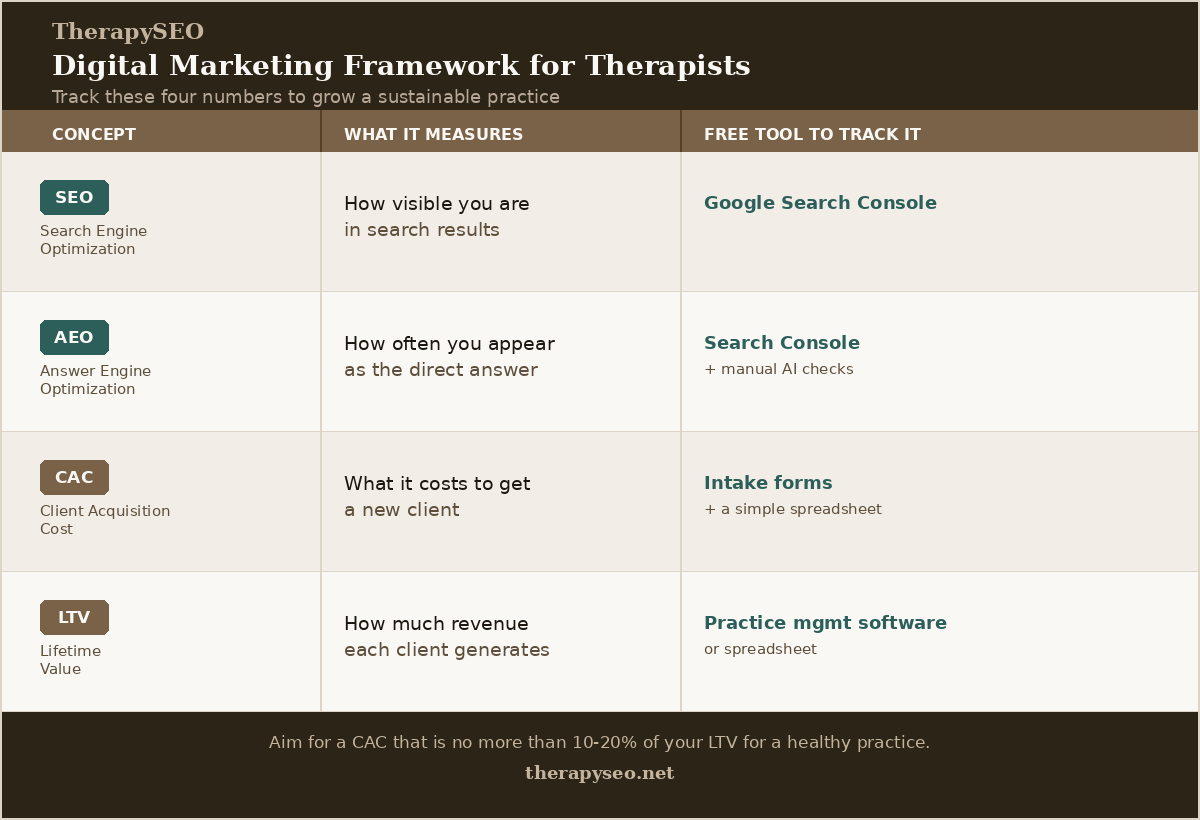
You do not need to nail all four at once. Start with one. A great first step is to:
Set up a free Google Search Console account and connect it to your website
Add an FAQ section to your website that answers the most common questions your clients ask
Start asking every new client how they found you
That alone puts you ahead of most therapy practices.
Frequently Asked Questions About Digital Marketing for Therapists
Do I need a big budget to market my therapy practice?
No. Many of the most effective strategies, including SEO, AEO, and a Google Business Profile, are completely free. Paid advertising can help accelerate growth, but it is not required to build a steady client base.
How long does SEO take to work?
SEO is a long game. Most practices start seeing meaningful results in three to six months, with stronger results building over one to two years. The earlier you start, the better.
Should I be on social media?
Social media can be a helpful supplement, but it is not a replacement for SEO and a strong website. If you enjoy it and have the time, it can help build trust and visibility. If it feels overwhelming, focus on your website first.
What is the difference between SEO and AEO?
SEO helps your website rank in the list of search results. AEO helps your content become the direct answer shown at the top of the page, inside AI tools, or through voice search. Both matter, and a lot of the work overlaps.
What if I am not tech-savvy?
Start small. You do not need to do everything at once. Set up Google Search Console, add an FAQ to your site, and ask new clients how they found you. Those three steps alone will give you valuable data and a stronger foundation.
Final Thoughts
Digital marketing can feel like a lot, especially when your real passion is helping people, not analyzing metrics. But think of it this way: the better your marketing works, the more people you can actually reach and help.
You do not need to become an expert. You just need to understand the basics, track a few key numbers, and keep improving over time. Start with SEO and AEO to get found, then use CAC and LTV to make sure your efforts are paying off.
Your future clients are out there searching right now. Let's make sure they can find you.